


You see it when you say “AI” in a brand meeting.
A lot of people eye roll, justifiably in a lot of instances, and think “not this s**t again”.
Some start thinking about margin, speed, and getting more done with the same team.
The others wonder whether this is how their job starts disappearing. And it’s this third group I want to talk to you about here.
If we look past the eye rolling cohort and assume that when you bring up “AI” it’s thought out and not just bulls**t.
The group who are gripped by something akin to fear and insecurity. You have a real problem, and so do they.
As a business, doing nothing on “AI” isn’t an option, because it’s a fair bet someone in your category is already automating processes, improving margins, or making decisions faster while you’re still figuring out where to begin.
Similarly, as an individual you can’t do nothing. Because organisations are changing, jobs are changing, and roles are / will change. This means individuals must develop new skills, and embrace change or risk losing their jobs.
So as a leader you’ve got to do two things at once. You can’t do nothing, and you can’t disregard your teams legitimate and valid fears out of hand.

Name the fear
Start by saying what everyone already knows. The tasks AI automates best sit between departments in the spreadsheets, manual data duplication, and endless trackers that exist.
This kind of work sits disproportionately in entry-level and coordinator roles. So, in a future where AI is embedded in a meaningful way it’s likely there’s fewer entry grade roles.
Weekly trade packs, routine reporting, first-pass copy.
That’s why the anxiety shows up hard in juniors, and why it snowballs into everyone else’s mood.
Under all the operator chat is the same question about whether this replaces me or my team. That question doesn’t get asked out loud very often, and it should.
If you don’t name it, people fill in the blanks for you. And that’s when you’ll experience lag, and rejection of change.
Then say the other bit leaders avoid. If we don’t adopt this stuff, we don’t stay static and safe, we get slower and more expensive than the brands that do. Which puts us at even greater threat.
It’s another way of saying - sooner or later, we’re f**ked if we don’t embrace this.
Repeat the rule
Give the team a simple rule and repeat it until it’s boring. Preserve headcount, multiply capacity.
That line matters because it forces you to pick an intent. The aim isn’t to rip out teams in favour of agents, it’s to go after the most painful bottlenecks and the most tedious work.
Don’t over-promise while you’re trying to reassure people. Preserving headcount doesn’t mean no role ever changes; it means you take responsibility for redesigning roles instead of using AI as a handy excuse for a redundancy round (see the countless tech bros fluffing up their share prices using this tactic).
Here’s how it shows up in plain English. We’re going to replace the dull and repetitive parts of the work. That work will be replaced. You won’t.
We’re going to invest in training so you can run the tools, judge the output, and know when not to use them. We’ll also be honest about the learning curve, because not everything we do will work first time (or ever).

Make it real in the workflow
Most AI chat inside brands gets stuck on the big existential stuff. Most operator reality is much less sexy and much more useful.
Where in my week is the highest-leverage thing AI can take off my plate?
You don’t need a big bang programme. You need momentum.
Start by taking reporting and reconciliation off someone’s plate, then focus them on increasing its quality and depth of analysis. Pick a workflow where boring, repeatable work is absorbing a big % of a person’s week, and map it end to end.
Agree what good looks like, what gets delegated to AI, and what stays with a human because it needs judgement.
If you’re trying to make preserve headcount, multiply capacity stick, you need a plan for the freed time before you free it. Talk in outputs and bottlenecks removed, not fluff.
If your merch team spends days building weekly trade packs, get the first cut done faster, then use the time to interrogate range performance properly. If finance is drowning in reconciliation, let AI take the first pass, then spend time fixing root causes instead of just clearing the queue.
If customer service is rammed with repetitive inbound, let automation handle the simple stuff, then redeploy the humans into the messy cases that actually lose you customers.
Don’t sell magic, sell standards
People will swear AI has made everything cheaper, then one failure and the whole org starts double-checking everything again.
That’s the paradox. Automations promise efficiency, but undetected failures create redundancy and duplication, and instead of freeing up capacity they exacerbate it.
AI is also in the mix before you’ve formalised it, take a walk through any office and you’ll see Claude or ChatGPT open on most desktops. It’s just used inconsistently and sometimes invisibly.
The risk isn’t that AI was used. It’s that it was used without accountability, by someone who couldn’t verify what they were looking at.
So set the boring rules early. Workflows, checks, clear lines on where data goes, and who signs off.
If you want people on side, don’t pretend quality control is optional. Tell people you expect them to use the tools, and you expect them to own the output.

Train the humans
A lot of leaders get stuck because they think the organisation needs a perfect AI strategy deck before it can act. In reality, most teams need to identify specific tasks worth automating and start building capability around those.
If you want a useful target that doesn’t spook everyone out, make it about tasks, not jobs.
If you say preserve headcount, you’ve also got to say we’ll help you get good at this. It’s a new muscle, and it won’t build itself.
And if you need help, for the love of god join Operator Experience and get multiple members of your team to the next events.
Focus on Catalysts
If preserve headcount, multiply capacity is the intent, Catalysts are how you make it real at pace.
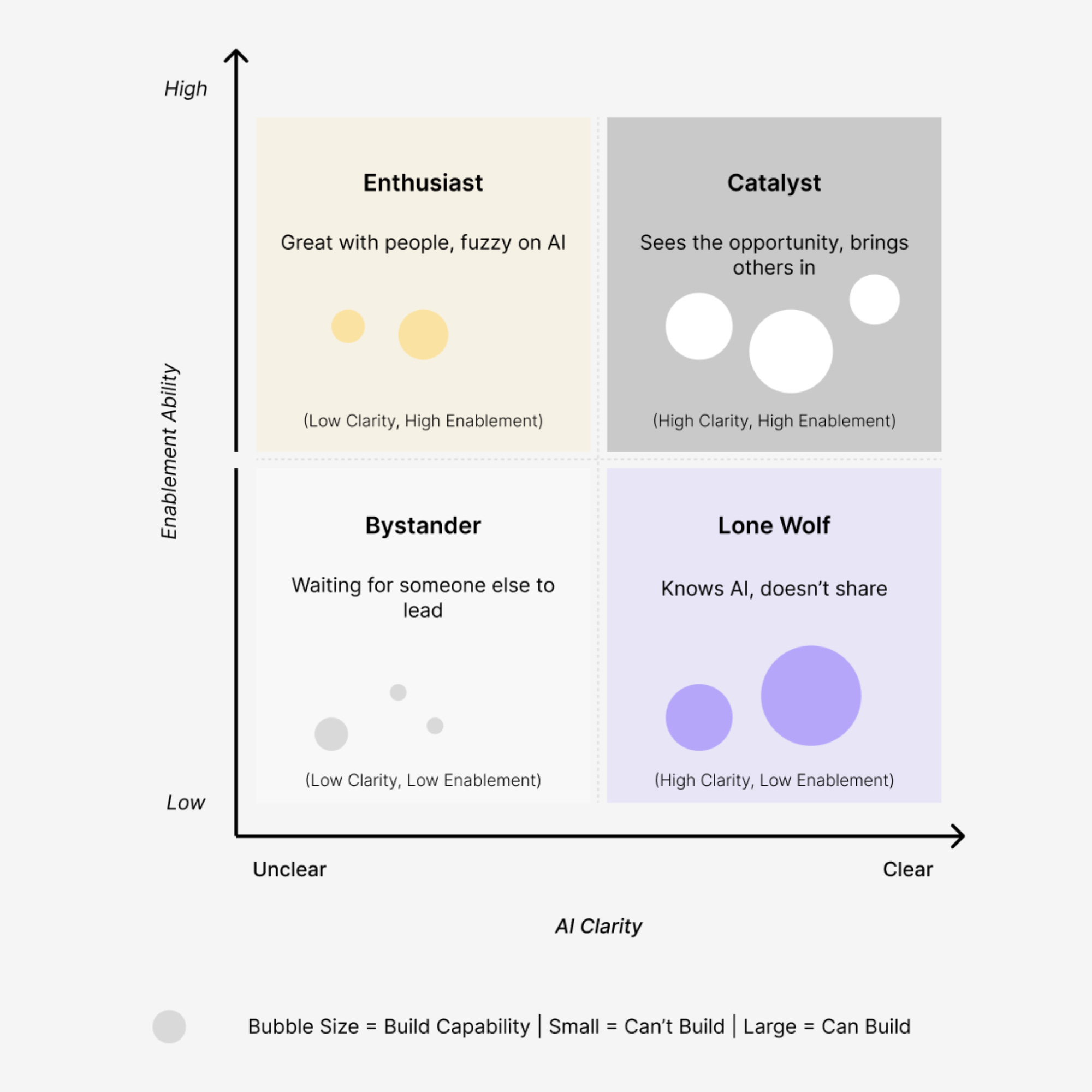
The framework I use maps people on two axes, AI clarity and enablement ability. Four profiles emerge.
The Catalyst is high clarity, high enablement. They see where AI fits, build something useful, and the team can actually run with it.
This matters because most org charts aren’t built for AI work to spread safely. You end up with a few good workflows trapped in someone’s head, and everyone else either ignores them or copies them badly.
Catalysts fix that, because they treat AI like an operating model shift, not a tool rollout. They’re the people who can turn a single win into a repeatable way of working, which is why Catalysts are going to be the scarce resource every brand is competing for.
You’ll spot them in how they talk. They don’t say we should use AI more; they say this is the bit of the trade pack that’s a time sink, this is the check we can’t drop, and this is how we’ll run it week to week.
This is where a lot of brands mess it up. They hire for build capability while ignoring enablement, and end up with a couple of clever workflows that nobody trusts and nobody learns from.
And watch the other failure mode as well. A lone wolf who can’t bring anyone with them isn’t a multiplier, they’re a bottleneck.
So if you’re trying to lower anxiety and raise adoption at the same time, don’t just go hunting for lone wolves. Build Catalysts, because they’re the people who make AI feel safer and more useful for everyone.
Give them a remit tied to real work, not AI theatre.
Give them time and permission to teach, document, and standardise.
Reward the people who make others better, not just the ones who ship the shiny thing.
And importantly, this profile is more learnable than people think. The rare Catalysts are more likely built than hired, because it’s a combination of understanding the work and bringing others along.
One last thing
Preserve headcount, multiply capacity is a sane middle path. It lets you move at the pace the market is forcing on you, without fracturing your business.
Have the conversation early, say the scary bits out loud, and then prove the intent in the day-to-day. People don’t need you to promise a risk-free future. They need you to show you’ve got a plan, and that they’re in it (if they embrace the change).
If you're heading into this conversation with your team and want a second pair of eyes on how to frame it, have that conversation with Luke first.