


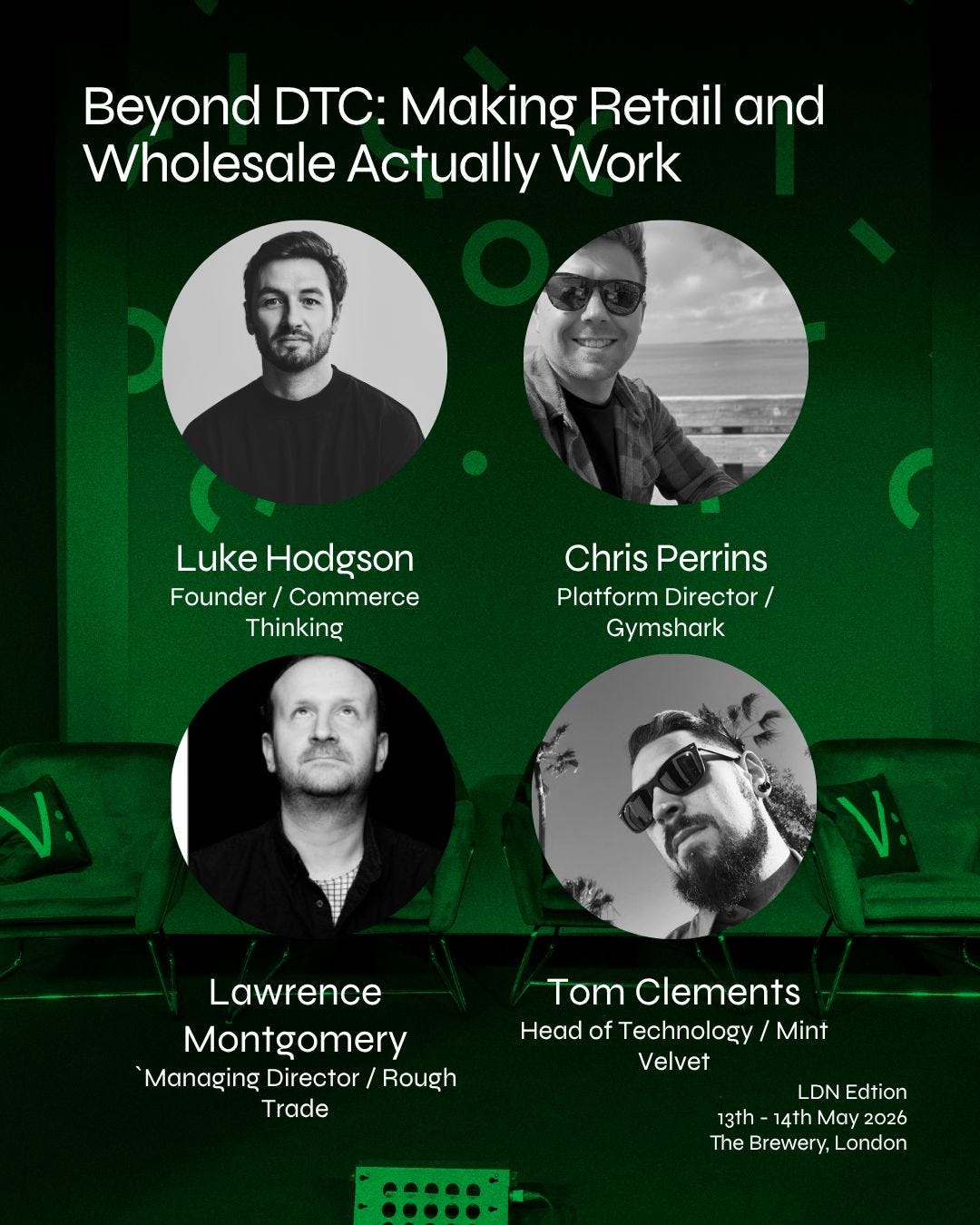
Beyond DTC: Making Retail and Wholesale Actually Work.
That was the panel title at Pulse, and the brief was straightforward. Get three operators who’ve expanded channels in the room and let them be honest about what broke.
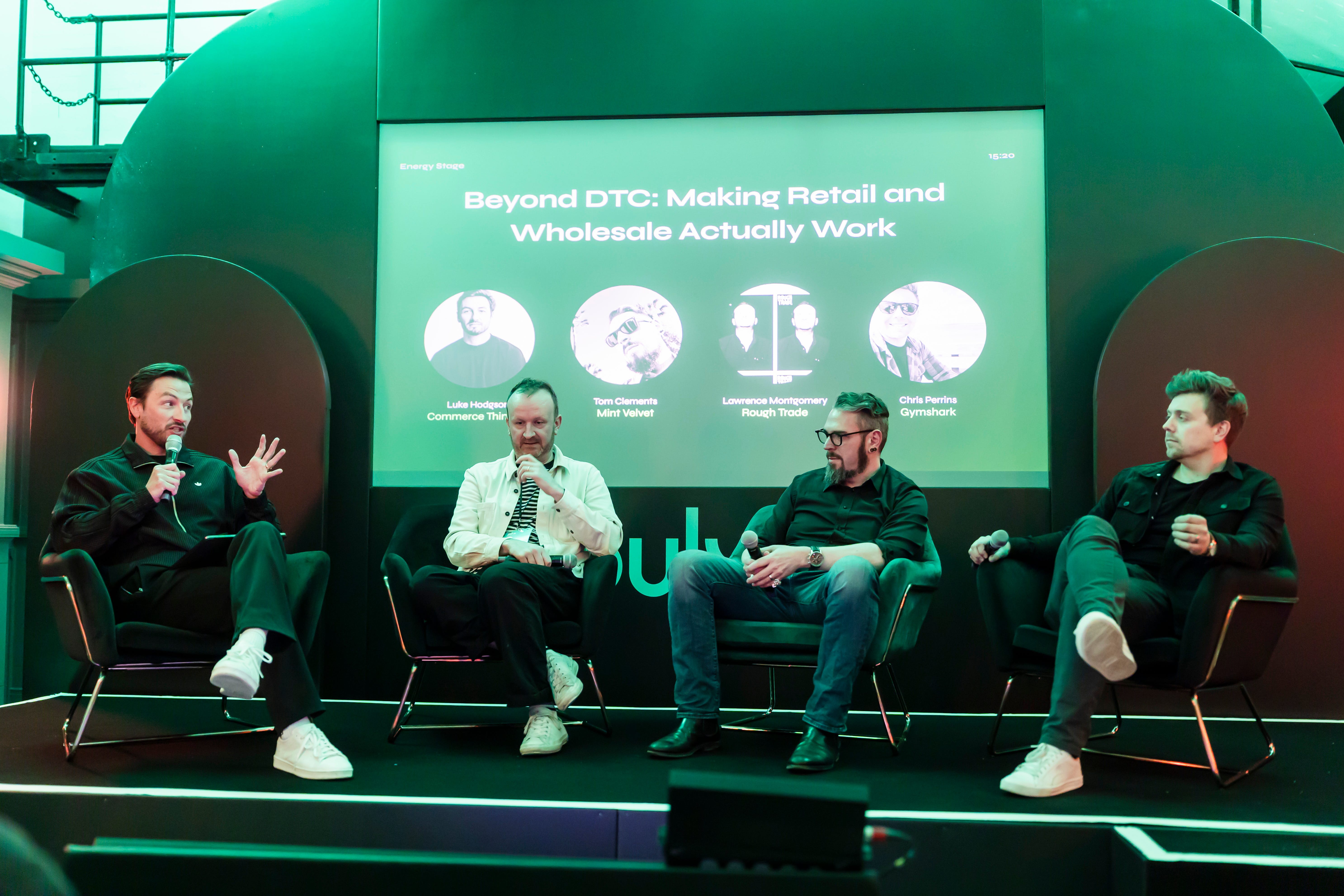
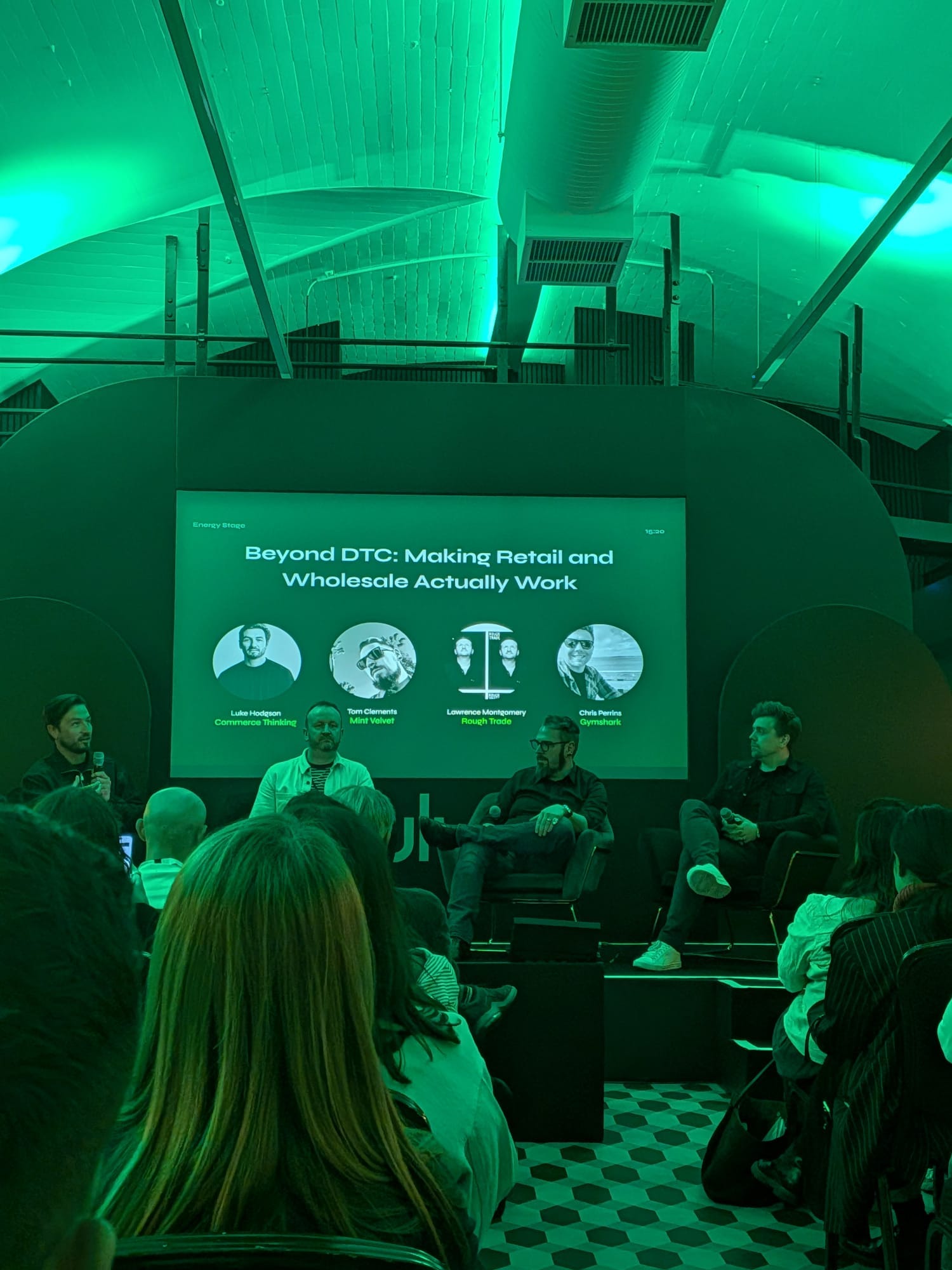
On stage: Lawrence Montgomery (MD, Rough Trade), Tom Clements (CTO, Mint Velvet) and Chris Perrins (Platform Director, Gymshark) and me moderating.
Three businesses with different starting points.
Rough Trade selling records and around 1,500 events a year across three markets, with email, Discord and ticketing on Dice in the mix.
Mint Velvet running 110 retail locations alongside its web business and partners like John Lewis and Next.
Gymshark, born online, now operating a Regent Street flagship, seven owned stores across the UK, Netherlands and US, MENA franchises, and wholesale partners including Selfridges.
Channels look identical. They aren’t.
The temptation to treat a new channel as a slightly different version of the existing one is universal. It’s also wrong.
Tom put it cleanly. Every channel is different. Every requirement for adding it is different. Clicking the add app button in Shopify Marketplace is trivial. What it means for data, inventory, ops and finance is not.
That asymmetry is where most of the unhappiness in multichannel expansion lives. The front end of adding a channel is usually quite easy. The back office consequences are not. Teams underestimate that gap and then spend the next two years closing it.
Don’t bundle your problems
Lawrence’s biggest lesson from Rough Trade’s Shopify migration was about scope.
Six hundred thousand SKUs. Three regional product catalogues being merged into one global one. A headless front end being rebuilt at the same time. The migration succeeded in headline terms but the product data issues that surfaced ten days after launch were not headline material. They were boring, granular, and degrading customer trust in ways that were hard to see at first and harder to reverse.
“We bundled too many problems into one problem,” he said. “What we should have done is taken each piecemeal and tackled them one by one.”
There was a second-order point in there too. He’d booked a work trip to New York the week after go-live. The realisation that something was wrong didn’t land for ten days, because in big migrations the problems sprinkle in rather than landing in one neat bundle. That cost him the headroom to react.

Rough Trade’s next big move is an ERP migration. The interesting thing isn’t that they’re doing it. It’s that they’re explicitly slowing it down. Shopify POS first. Other prerequisites second. ERP six months later than they’d like. The discipline is in the sequencing, not the ambition.

Wholesale runs on a different clock
Chris was direct on this. Online forgives missed dates. Wholesale doesn’t.
If a freight delay or a production slip hits a DTC drop, you can usually absorb it quietly. If you’re shipping to a wholesale partner who’s planned their revenue around your stock landing on a date, you can’t. The calendar isn’t yours anymore.
“You have to hardball yourself closer to account for dates you need to hit,” he said. “That becomes really intrinsic to your whole operation.”
A lot of brand-side teams interrogate the commercial side of a wholesale relationship and never quite get to the production calendar implications. That’s usually the bit that hurts later.
Retail will eat your DC playbook
The Gymshark Regent Street story deserves its own headline.
They opened with what was effectively a mini DC inside the store. Roughly thirty thousand units, four to five thousand SKUs, bins, locations, the lot. Scannable, sophisticated, traceable. Any unit findable in seconds. A pair of black shorts that looks very similar to another pair of black shorts? Not a problem. Location A12. Done.
Six months later, everything was everywhere.

The system hadn’t failed. The conditions around it had. Retail has high staff turnover. Training has to keep pace. Sophisticated operations need monitoring and reinforcement. None of that happens easily in a flagship store running on retail rhythms.
“Retail is fast. Retail is demanding. You can’t put a mini DC in a store, no matter how many units you have. Keep it simple.”
The instinct to over-engineer is what catches DTC-native teams in stores. They assume retail can run on warehouse logic. It can’t, because the team composition, the pace, and the incentives are all different.
Get finance, ops and merch in the room early
This kept coming up.
New channels look like front-end decisions. They aren’t. They land hardest on the teams who don’t get invited to the early conversations. Tom’s advice was to shift left. Find the problems before launch, not a month after, when finance walks in with a question nobody can answer.
It’s a familiar pattern. Most channel launches we see at Commerce Thinking that go sideways don’t fail in marketing or fit-out. They fail in the back office, because finance, ops and merch were brought in too late to flag the things that were always going to surface. By the time the data inconsistencies show up in a P&L, the trust is gone. By the time ops realises the warehouse can’t handle the wholesale pick profile, the partner is already unhappy.
The fix is unglamorous. Involve those teams at the planning stage, not the go-live stage.

What it actually adds up to
The thread running through all of this. A new channel is a new business inside your business. Treat it like one.
Different calendar. Different operating model. Different data shape. Different people. Different problems.
The brands that scale across channels successfully aren’t the ones with the most ambition. They’re the ones who slow down enough to sequence the work properly, who let the back office in early, and who don’t assume the next channel will behave like the last one.
It almost never does.